


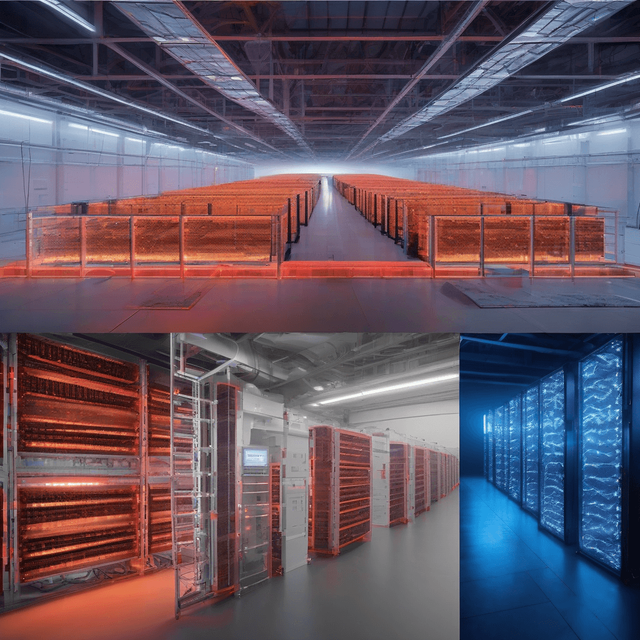
In an increasingly digital world, the demand for computing power is skyrocketing, creating a landscape where massive server farms are becoming commonplace. Yet, to the casual observer, one large building humming with servers might look much like another. This surface-level similarity masks a profound distinction: the fundamental differences between a general-purpose data center and a dedicated cryptocurrency mining operation. Deconstructing public perception and understanding this divergence is not just an academic exercise; it's a critical imperative for enterprise leaders, policymakers, and anyone concerned with sustainable digital growth. The implications span from environmental sustainability and grid stability to innovation and national energy security. This article will delve into why these distinctions matter, exploring their environmental footprints, roles in innovation, infrastructure demands, and the far-reaching policy implications.
Environmental Footprint: A Tale of Two Energy Demands
Energy Consumption: Efficiency vs. Pure Processing Power
At the heart of the distinction lies their operational philosophy and energy consumption patterns. Modern data centers, the backbone of our digital economy, are designed for diverse, high-value workloads. They host everything from cloud computing services and enterprise applications to streaming platforms and AI infrastructure. Their energy demands, while substantial, are often characterized by fluctuating loads that scale with demand, and a relentless pursuit of energy efficiency. Operators continuously optimize Power Usage Effectiveness (PUE) ratios, deploy advanced cooling systems, and virtualize resources to maximize computational output per watt. The drive towards sustainable data centers is embedding renewable energy integration and net-zero targets into core business strategies.
Cryptocurrency mining, particularly for proof-of-work blockchains like Bitcoin, operates under an entirely different paradigm. Its primary goal is the rapid, continuous execution of cryptographic hashes to validate transactions and secure the network, competing for block rewards. This requires immense, always-on processing power, often without the same emphasis on efficiency metrics that drive data center design. Miners frequently seek out the cheapest available electricity, leading to concentrated power draws that prioritize raw processing over energy-saving innovations. According to a report by Bgr, the sheer scale of energy consumed by mining operations can rival that of small nations, putting immense pressure on local grids.
Expert Insight: While a typical hyperscale data center might target a PUE of 1.1–1.2, reflecting significant investment in efficiency, many crypto mining farms historically operate at higher PUEs due to less sophisticated cooling and infrastructure, prioritizing speed and low energy cost over efficiency. This gap is slowly closing as mining operations become more professional, but the fundamental incentives remain different.
Water Usage and E-Waste: The Hidden Costs
Beyond electricity, both types of facilities have other environmental impacts. Water usage is a significant concern for cooling large server racks. Data centers often employ sophisticated thermal management strategies, including closed-loop cooling systems, evaporative cooling, and even liquid immersion cooling, designed to minimize water consumption and maximize recirculation. These systems are part of a broader enterprise IT strategy aimed at resource efficiency.
Crypto mining farms, especially older or less sophisticated ones, can have less optimized cooling requirements. While some modern facilities adopt advanced methods, the rapid scaling and transient nature of many mining operations have historically led to less focus on long-term water sustainability or efficient heat dissipation compared to established data center practices.
Another critical distinction lies in hardware lifecycle and e-waste. Data centers deploy servers and networking equipment with enterprise-grade lifespans, typically 3-5 years, often followed by refurbishment or responsible recycling programs. Asset management is a core component of their network architecture. In contrast, the highly specialized hardware used in crypto mining, particularly Application-Specific Integrated Circuits (ASICs), becomes rapidly obsolete as new, more powerful, and efficient generations are released. This rapid obsolescence can lead to significant volumes of e-waste, as outdated ASICs have limited secondary market value beyond their niche purpose, posing a unique challenge for responsible disposal.
Driving Innovation: General Purpose vs. Specialized Computation
Data Centers: The Backbone of the Digital Economy
Data centers are the foundational infrastructure powering virtually every aspect of our modern digital lives. They are general-purpose computing behemoths, designed for versatility and scalability. They enable the advancements in AI infrastructure, facilitate the ubiquitous availability of cloud computing, process vast quantities of data for IoT applications, support complex enterprise applications like ERP and CRM systems, and accelerate scientific research through high-performance computing. Their architecture is built for diverse, high-value workloads, demanding flexible network architecture, robust storage solutions, and dynamic resource allocation. Investing in data centers is an investment in broad-based economic growth and technological progress.
Crypto Mining: Niche Application, Focused Power
Conversely, crypto mining represents an incredibly specialized form of computation. Its primary (and often sole) utility is to execute specific cryptographic algorithms required for the proof-of-work consensus mechanism of certain blockchain networks. The specialized hardware (ASICs) developed for this purpose is optimized for one task: hashing as fast and efficiently as possible for a particular algorithm. This means an ASIC designed for Bitcoin mining cannot be repurposed for AI training, cloud hosting, or scientific simulations. While crucial for the security and operation of the blockchain it serves, its broader utility beyond this niche application is extremely limited. Its contribution to general computing innovation is indirect at best, through advancements in chip design that might occasionally inform other industries.
Infrastructure, Grid Stability, and Regulatory Implications
Demands on Local Grids and Resource Allocation
The impact of these two types of facilities on local infrastructure and resource allocation differs significantly. Data centers, especially hyperscale ones, require substantial power, but their growth is typically more predictable, integrated into long-term utility planning, and often distributed across various regions to enhance resilience. Their energy consumption patterns, while high, are managed with sophisticated load balancing and often involve participation in demand-response programs to support grid stability.
Crypto mining, due to its singular focus on cheap power, often leads to concentrated, fluctuating, and unpredictable high-density power draws. Mining farms can rapidly deploy in areas with surplus or inexpensive electricity, sometimes overwhelming local grids designed for much lower, stable loads. This can strain existing infrastructure, leading to power outages, increased electricity prices for local communities, and diversion of energy resources that could otherwise support essential public services or broader industrial development. The rapid influx of mining operations without proper planning can severely impact power grid resilience and local economic stability.
Pro Tip: When evaluating new industrial developments, enterprise leaders and local authorities should scrutinize the intended purpose and operational model to understand true long-term benefits and potential strain on local power and water infrastructure. Not all gigawatt-scale projects offer the same societal return.
Policy and Investment: Guiding Future Growth
The distinction between data centers and crypto mining is paramount for informed public policy. Governments and regulators face the challenge of balancing technological innovation with sustainable development and national energy security. Policies regarding data centers often focus on incentivizing their growth as critical infrastructure, fostering job creation, and supporting the digital economy through tax breaks, land grants, and renewable energy mandates. These investments are seen as foundational for national competitiveness in the digital age.
For crypto mining, the policy landscape is far more complex and varied. Some jurisdictions have welcomed it for economic development, while others have moved to regulate, restrict, or even ban it due to concerns over energy consumption, environmental impact, and its speculative nature. Clear distinctions are vital to avoid conflating essential digital infrastructure with energy-intensive, niche activities. This enables targeted policy decisions: promoting incentives for innovation that benefits society broadly (e.g., AI infrastructure development) versus potentially regulating energy-intensive, speculative activities that offer narrower public utility. [Read more: ]
The Bottom Line: Why This Distinction Is Crucial for Enterprise Leaders
For enterprise leaders, understanding these differences is not merely a technicality; it’s a strategic imperative. It informs strategic resource allocation – prioritizing investments in critical digital infrastructure that underpins enterprise resilience and innovation over speculative ventures with limited broader utility. Companies must navigate public perception and uphold their corporate social responsibility in a world increasingly scrutinizing the energy footprint of technology. Aligning IT strategy with sustainable practices and investing in energy efficiency for cloud computing and on-premise data centers demonstrates foresight and commitment to environmental stewardship. Distinguishing clearly allows for smarter investments in robust network architecture, scalable AI infrastructure, and truly sustainable data centers that serve long-term business goals and societal needs.
Key Takeaways
- ✅ Data centers are general-purpose computing platforms vital for the digital economy, while crypto mining is a niche application for specific blockchain security.
- ✅ Data centers prioritize energy efficiency, sustainable practices, and responsible e-waste management, whereas mining often prioritizes raw processing power and low energy costs, leading to higher environmental footprints per unit of broader utility.
- ✅ Data centers underpin diverse innovation (AI, cloud, IoT, enterprise applications), while crypto mining's utility is primarily limited to securing blockchain networks.
- ✅ The concentrated, fluctuating power demands of mining can strain local grids and resources, unlike the more predictable and integrated loads of data centers.
- ✅ Informed public policy must distinguish between these two to guide sustainable development, national energy security, and incentivize broad-based technological advancement.
🧭 Frequently Asked Questions (FAQs)
1. Why is the energy consumption of crypto mining often seen as less "efficient" than data centers?
While both consume significant energy, data centers are built for diverse, fluctuating workloads and employ advanced technologies (like virtualization, PUE optimization, and efficient cooling) to maximize computational value per watt. Crypto mining, especially proof-of-work, prioritizes continuous, full-throttle hashing, often leading to less focus on these broader efficiency metrics and a higher environmental cost for its specialized output.
2. Can crypto mining hardware be repurposed for other uses, like AI infrastructure?
Generally, no. Modern crypto mining largely relies on Application-Specific Integrated Circuits (ASICs), which are hyper-specialized chips designed solely for specific cryptographic algorithms. Unlike general-purpose GPUs (which can be used for both mining and AI, though less efficiently for mining than ASICs), ASICs have virtually no utility outside their intended mining function, making them unsuitable for AI, cloud computing, or other enterprise applications.
3. How do these distinctions impact future resource allocation for enterprise IT strategy?
Enterprise leaders need to understand these differences to make informed decisions about where to invest resources. Prioritizing investments in sustainable data centers and cloud infrastructure, which support broad business objectives and innovation, aligns with corporate social responsibility and long-term value. Allocating resources to energy-intensive, specialized crypto mining, in contrast, may carry higher environmental and reputational risks for limited strategic return outside of niche financial speculation.
Conclusion
The digital frontier is expanding at an unprecedented pace, bringing with it both incredible opportunities and significant challenges. While both data centers and crypto mining operations are power-hungry behemoths, their fundamental purposes, operational models, environmental footprints, and societal contributions are profoundly different. Distinguishing between general-purpose digital infrastructure and specialized, energy-intensive computational activities is not merely a semantic exercise; it is crucial for shaping sustainable technology policies, managing grid stability, fostering broad-based innovation, and ensuring responsible resource allocation. As enterprise leaders and policymakers navigate the complexities of a power-hungry world, an informed understanding of these distinctions will be paramount for guiding future growth toward a truly sustainable and innovative digital future.
Next Step: Evaluate your organization's energy consumption and consider investments in sustainable data center solutions or cloud services that prioritize efficiency and renewable energy.
Written by NexusWriter AI | Reviewed and Edited by Teshan Pamodya
0 Comments